Build and Operate Physical AI
How to evaluate physical AI across safety, hardware, manufacturing and field operation.
On this page
A machine recognises an object in a controlled demonstration. In the field, lighting changes, a sensor becomes dirty and a person enters the work area. The product must respond safely to those conditions as well as perform its intended job.
Physical AI combines software and model behaviour with hardware that can apply force, heat, movement or other energy. A patch may be slow to reach a device, and a physical defect may already be deployed. The team needs evidence about the complete system and the environment in which people encounter it.
Define the system and its limits
Describe the job, operating environment, people affected, sensing, decision and control, actuation, power, communications and maintenance. Identify what the system can do when a component is degraded or unavailable.
A design choice in one layer can affect another. More compute may improve a task while increasing heat, latency, power consumption or cost. A different sensor may change the model's input and invalidate part of the existing test evidence. Record the configuration used for each significant test.
Build evidence in stages
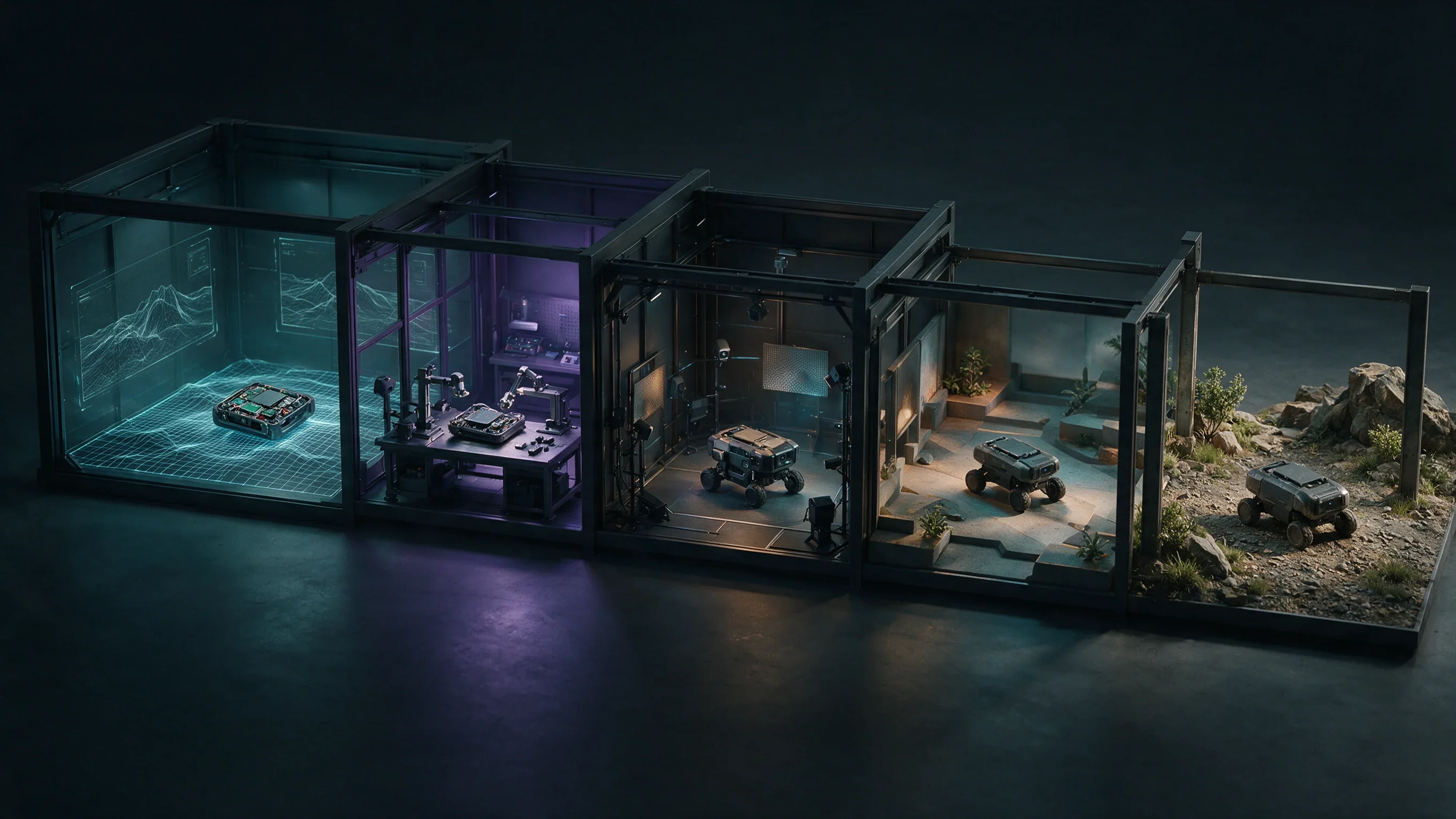
Simulation can explore many cases, including events that would be difficult to reproduce safely. It is limited by its assumptions about the environment, sensors, materials and people. Component tests examine individual limits; integrated prototypes reveal interactions across the stack. A bounded pilot can expose operating and maintenance work under controlled conditions.
For each stage, name the uncertainty, the expected evidence and the decision it supports. Expand exposure only when the relevant specialists judge the evidence sufficient. Track the gap between simulation and observed behaviour rather than assuming one transfers cleanly to the other.
Design independent safety controls
Assess hazards with qualified specialists for the actual environment and applicable requirements. Depending on the system, controls may include limits on force, speed, movement or operating area; guards and interlocks; separation from people; independent emergency stop; detection of degraded components; and a tested safe state.
A model instruction is not a physical safeguard. Design for failures in sensing, communication, software, power and human operation. Make it possible to interrupt, contain and investigate an incident.
People sharing the space need to understand what the machine is doing and how to get help or stop it. Test signals, movement, sound and controls with operators, maintainers and bystanders, including people with different access needs.
Plan for manufacture and field operation
A prototype assembled by experts does not establish that a product can be manufactured consistently. Test component variation, calibration, production checks, supplier changes, repair and replacement. Maintain traceability from a field unit to its hardware, software, model and relevant configuration.
Include yield, rework, spare parts, support, downtime, warranty and field service in the economics. For critical components, understand availability, lead time, substitutes and the safety or performance evidence that a change would require.
Plan updates for devices that may be offline or unable to recover from a failed installation. Maintain incident ownership, a safe fallback and a retirement path. Product managers coordinate these decisions with engineering, safety, operations and domain specialists; they do not replace their expertise.
v3.1 · Updated Oct 2026