AI-Native Teams Need Generalists and Specialists
How to design AI-enabled teams around a generalist core, specialist depth, agent stewardship, review capacity, and the risk in the work.
On this page
- 1.Build around a generalist core
- 2.Pull specialists in by trigger
- 3.Choose topology by work
- 4.Staff for judgement, depth, and learning
- 5.New responsibilities appear around agents
- 6.Review capacity shapes the team
- 7.Managers design the conditions
- 8.Design apprenticeship deliberately
- 9.Keep teams coherent as roles blur
- 10.The team design review
- 11.Anti-pattern: headcount strategy disguised as transformation
TL;DR
- AI expands what generalists can do, but it does not remove the need for deep expertise where consequences, complexity, or craft are high.
- Team shape should follow the work: a small generalist core, specialists pulled in by risk, and platform capabilities that remove repeated operational burden.
- Design for decision quality, review capacity, stewardship, and learning. Headcount reduction is not an operating model.
AI-native team design is often reduced to a smaller org chart. That misses the work.
Generalists can now cross boundaries that once required formal handoffs. A PM can query data and build a working flow. A designer can make a production pull request. An engineer can synthesise customer evidence. This reduces coordination around routine work.
The same tools also increase output, review load, operational surface area, and the cost of weak judgement. Deep systems expertise, design craft, research, security, data science, and domain knowledge remain decisive when the work demands them.
Optimise for the smallest team with enough judgement and depth to own the outcome safely.
Build around a generalist core
The core team owns the problem, customer context, outcome, and day-to-day decisions. Members have a primary craft and working fluency across adjacent disciplines.
A strong core can:
- Speak directly with users
- Shape the problem and commercial outcome
- Produce the artefact needed for the next decision
- Build and evaluate working software
- Interpret product data
- Release and observe changes
- Recognise when the work exceeds its depth
The last capability matters most. Generalism becomes dangerous when people cannot see the edge of their competence.
Use AI to cross low-risk boundaries. Pull in specialists when craft or consequence becomes material.
Pull specialists in by trigger
Do not staff every skill permanently into every team. Do not pretend every skill is interchangeable either.
Define specialist triggers:
| Specialist depth | Pull them in when... |
|---|---|
| Product design | The interaction is novel, emotionally sensitive, accessibility-critical, or central to differentiation |
| Research | The user population is hard to reach, the behaviour is poorly understood, or the decision depends on interpretation rather than volume |
| Data science | Causal inference, ranking, pricing, experimentation, forecasting, or measurement validity affects the decision |
| Security and privacy | The system handles sensitive data, untrusted input, external actions, or new attack surfaces |
| Domain expert | Errors carry professional, regulatory, financial, health, or safety consequences |
| Systems engineering | Reliability, performance, architecture, migrations, or scale exceed product-generalist depth |
| Legal and compliance | Obligations, disclosure, data use, or accountability are unclear or material |
Specialists should enter early enough to shape the approach, not arrive as a late approval gate. The team remains accountable for integrating their judgement.
Choose topology by work
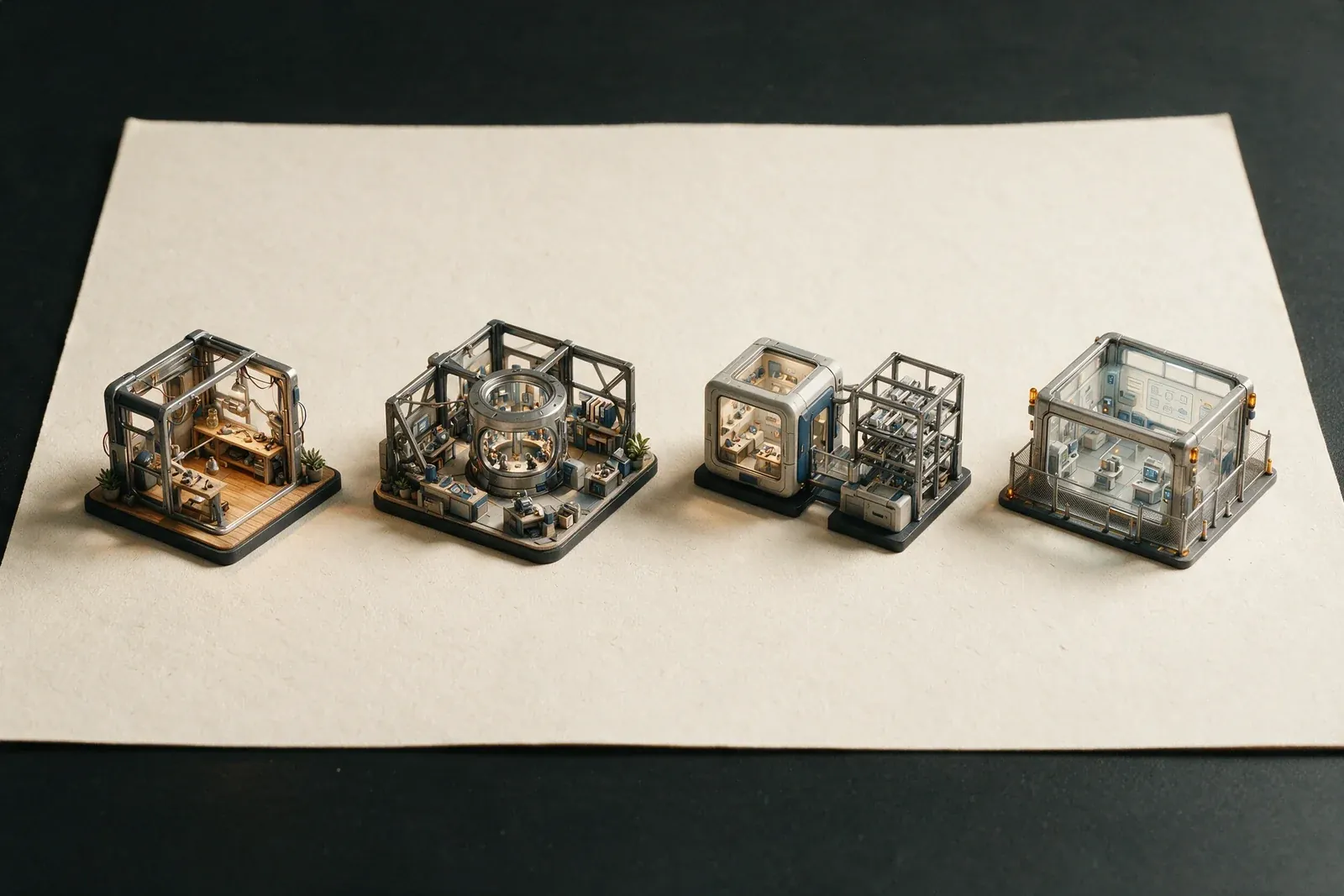
No team shape wins everywhere. Use the pattern that matches uncertainty, coupling, and risk.
Builder pod
A small cross-functional group owns a bounded problem and can release independently.
Use when the domain is understood, dependencies are limited, and changes are reversible. The benefit is rapid decision-making. The risk is shallow review and local optimisation.
Generalist core with specialist bench
A stable core pulls in senior specialists for specific decisions or phases.
Use when most work is tractable across disciplines but occasional decisions demand depth. This is a strong default for many product teams.
Product and platform pair
A product team owns user value while a platform team owns shared AI infrastructure, eval tooling, identity, observability, and deployment paths.
Use when several teams repeat the same operational work. The platform exists to increase product-team autonomy, not to centralise every model decision.
Regulated cell
Product, engineering, domain, risk, security, and compliance ownership are explicit inside one operating group.
Use when decisions carry legal or customer harm. Fast access to specialists is more valuable than a small nominal team.
Exploration cell
A temporary group combines product judgement, design, technical experimentation, and customer access around a high-uncertainty opportunity.
Use to resolve a strategic unknown. Give it a decision deadline. Do not let it become a permanent innovation theatre team.
Staff for judgement, depth, and learning
Ask which judgements the team must make repeatedly and where a wrong decision could cause material harm. Staff for those demands before counting implementation tasks.
Map work across four dimensions:
| Dimension | Team implication |
|---|---|
| Repetition | Repeated, well-specified work may suit automation or a shared platform |
| Judgement | Ambiguous trade-offs require experienced accountable people |
| Consequence | High-impact errors require specialist depth and stronger review |
| Learning | Novel work requires people who can run evidence loops and update direction |
Do not label repetitive work “safe to eliminate”. Automation can scale mistakes and create new review queues. Redesign the workflow, measure the operating load, and then decide how roles change.
New responsibilities appear around agents
Agents do not enter an org chart as free capacity. They create stewardship work.
Teams need explicit responsibility for:
- Defining the job and quality bar
- Maintaining context and instructions
- Controlling tools and permissions
- Reviewing escalations and samples
- Updating evals after failures
- Managing cost and latency
- Responding to incidents
- Retiring unused agents and credentials
This may sit with an existing product or platform owner. In larger organisations, agent operations may become a specialised capability. Either way, the responsibility must appear in capacity planning.
Every Agent Needs an Owner defines the operating contract.
Review capacity shapes the team
Generation capacity is not throughput. A team that can create forty changes and review ten has a ten-change system with a growing queue.
Staff and plan for:
- Code and architecture review
- Product and design critique
- Eval design and failure analysis
- Security and privacy review
- Operational escalation
- Customer feedback and support
Automate deterministic checks. Sample repeatable low-risk work. Preserve full human review for consequential decisions. The mix should follow risk rather than hierarchy.
Senior specialists should spend more time on standards, difficult cases, and system design, not become approval queues for routine work.
Managers design the conditions
An AI-fluent manager who improves only their own output has not transformed the team.
Managers own five conditions.
Clear authority
Teams know which decisions they can make, which actions require review, and which risks need escalation. Autonomy without boundaries creates hesitation or accidental overreach.
Protected improvement time
Reusable prompts, evals, context, automation, and platform improvements compete with delivery. If no capacity is protected, teams remain trapped in personal productivity.
Shared practice
People show how they use tools, compare approaches, and publish working patterns. Fluency should become team infrastructure rather than private advantage.
Sustainable workload
Managers remove low-value work, limit concurrent bets, and monitor review queues. More generated output is not a reason to fill every recovered hour.
Deliberate social learning
Pairing, critique, incident review, and apprenticeship preserve the human learning that disappears when everyone works privately with an agent.
Design apprenticeship deliberately
AI can remove the routine tasks through which junior people once learned the system. It can also give them access to explanation, simulation, and production capability earlier. Whether development improves depends on team design.
Give junior people exposure to the full learning loop:
- Observe customer and field work before generating a solution
- Predict an approach before asking an agent
- Review diffs, traces, evidence, and failures with an experienced practitioner
- Own bounded production work with real feedback and a clear escalation path
- Participate in incidents, retrospectives, design critique, and evaluation reviews
- Explain why a generated result is correct, not only demonstrate that it works
Senior people should teach standards and boundary judgement rather than becoming a queue for final approval. Pair on ambiguous cases where reasoning is visible.
Reverse mentoring matters too. People who adopted AI tools early may see useful workflows, interaction patterns, and capability changes that experienced leaders miss. Give them a path to teach the team without asking them to carry production risk beyond their depth.
Track development evidence. Are junior people encountering enough varied work to recognise failure? Can they make a bounded decision without the agent? Are specialists creating reusable guidance while still practising their craft?
Preserve the experiences that build judgement without retaining old tasks for their own sake. Then find a better way to provide those experiences.
The sustainable AI work principle covers pace and hidden operating load.
Keep teams coherent as roles blur
Role boundaries becoming permeable does not mean craft disappears.
Use three expectations:
- Primary depth: every person has a craft where they can set a standard and correct others.
- Adjacent fluency: they can perform lower-risk work across neighbouring disciplines and collaborate without handoff theatre.
- Boundary judgement: they recognise when the decision needs deeper expertise.
This produces E-shaped teams: broad collaboration, one or more areas of depth, and the judgement to move between them.
The team design review
Review team shape against the work each quarter:
- Which decisions consume the most senior judgement?
- Where is specialist depth arriving too late?
- Which repeated work should become platform capability?
- Where has agent maintenance created hidden load?
- Which review queue limits throughput?
- What work should stop?
- Are junior people still seeing enough work to develop judgement?
Org design is an ongoing product decision. Tool capability, product risk, and team fluency all move. The AI adoption operating model covers how a proven workflow spreads across teams before roles are redesigned around it.
Anti-pattern: headcount strategy disguised as transformation
Leadership announces that AI allows every team to shrink. Roles are removed before workflows, permissions, evals, support, and review have been redesigned.
The remaining generalists inherit more scope and a larger operating surface. Specialists become shared bottlenecks. Managers point to higher output while incidents and fatigue rise.
That is cost reduction, not AI-native team design.
Empowered Teams defines the authority model. This chapter defines the composition and operating capacity required to use that authority well.
v3.1 · Updated July 2026