AI Is a Five-Layer Cake. Pick the Slice That Keeps Paying.
TL;DR
- Jensen Huang describes AI as a five-layer cake: energy, chips, systems, models, applications. Every layer has to succeed, but they don't pay the same. Only the application layer compounds returns for whoever owns it.
- I run two production vertical SaaS platforms that orchestrate six different LLMs. Every time a frontier model improves, my product gets better for free. I didn't fund that research. I inherited it.
- Most AI product leaders are competing at the wrong layer. The honest test: if your team's roadmap is optimising prompts, swapping models, or benchmarking your router, you're doing model-layer work. The compounding slice is the workflow above it.
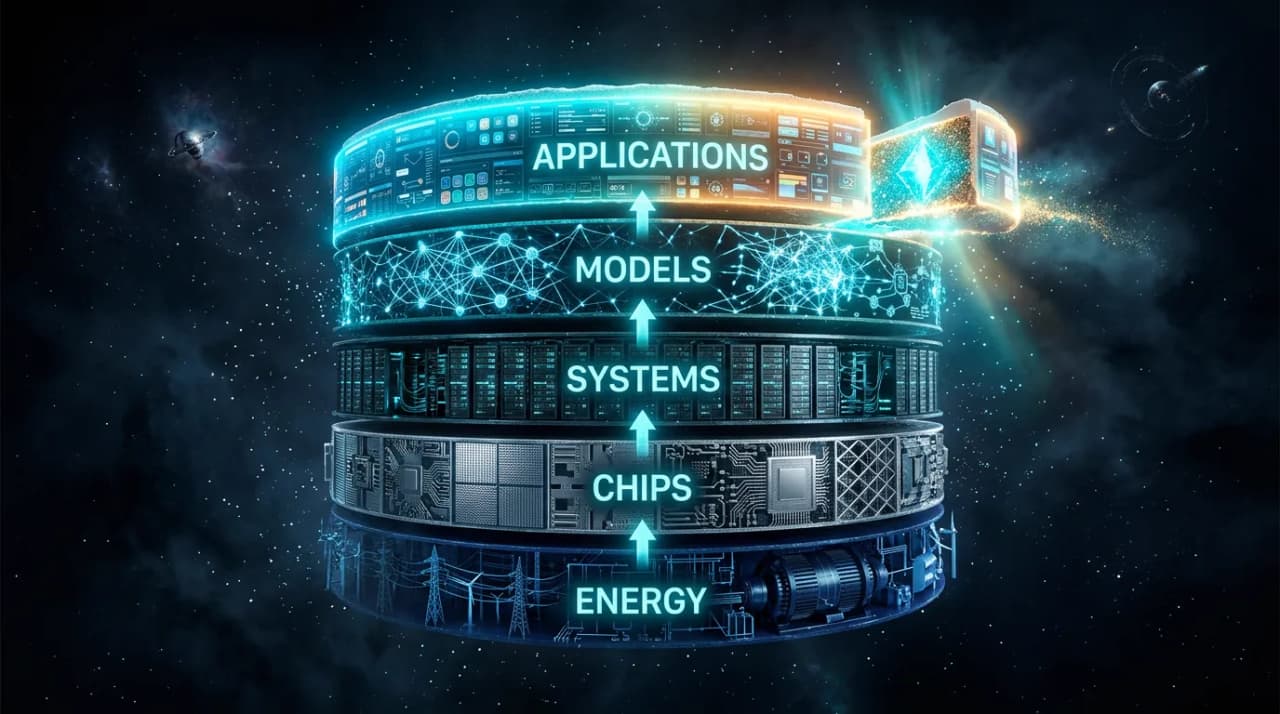
Jensen Huang has a mental model for AI that's worth stealing. He laid it out in a recent interview with Dwarkesh Patel, and I've been turning it over since. He calls it a five-layer cake: energy at the bottom, then chips, then systems, then models, then applications at the top. Every layer has to succeed for the industry to work. None of them can be skipped. But each layer behaves differently as an investment, and most AI product leaders I talk to are quietly playing at the wrong one.
The cake metaphor matters because it forces a question most AI strategy decks dodge: which layer are you actually trying to win, and does that layer compound for you? Not every slice pays the same. Some pay once. Some pay forever. Some don't pay you at all because someone else already owns the rent extraction point.
| Layer | Who wins | Capital required | Moat type | Your play |
|---|---|---|---|---|
| 1. Energy | Utilities, nuclear, geothermal, grid operators | Billions, decades | Regulatory, physical | Not your layer |
| 2. Chips | Nvidia, TSMC, SK Hynix, ASML | Tens of billions per fab | Process node, EUV access | Downstream beneficiary |
| 3. Systems | Hyperscalers, CoreWeave, Crusoe, Nebius | Hundreds of millions | Ecosystem, install base, ops | Rent, don't build |
| 4. Models | OpenAI, Anthropic, Google DeepMind, xAI, open-weight labs | Billions, top-1% talent | Data, training scale, safety | Orchestrate, don't train |
| 5. Applications | Linear, HubSpot, OpenChair, OpenTradie, every vertical SaaS | A rounding error | Workflow, context, trust, integrations | This is your layer |
Walk the layers. See what's happening at each one, and why the top layer is where the durable returns sit for almost everyone reading this.
Layer 1: Energy, the binding constraint
The bottom of the cake is electrons. Power generation, grid capacity, substation throughput, cooling water. The US can't build AI factories without power, and the queue for grid interconnection is measured in years.
Who wins here: utilities, gas-peaker operators, nuclear restarts, geothermal pilots, and whoever can get a 500MW site permitted in under 18 months. It's a capital-intensive, regulated, slow-moving layer. Returns are real but the clock is brutal. You are a product leader reading this, so this is not your layer.
What you should notice: energy is the binding constraint upstream of everything you'll ever ship. If someone tells you AI is about to get dramatically cheaper in 2027, ask them what they think happens to the Texas grid first.
Layer 2: Chips, the highest-margin slice
Silicon. Lithography. Packaging. High-bandwidth memory. The photonics layer between sockets. This is the layer where Nvidia and TSMC currently print money, and where the geopolitics of EUV machines actually determine national AI capacity.
Who wins here: Nvidia, TSMC, SK Hynix, Micron, ASML, and a constellation of packaging and networking specialists who are newly important because the single-chip era is over. Margin is the highest anywhere in the cake. Capex is also the highest, measured in tens of billions per fab.
What you should notice: this is the layer everyone writes about because Nvidia's earnings are theatre. It's not the layer where you live. The relevant fact for you is that chip throughput is what makes your token costs fall over time. You're a downstream beneficiary, not a participant.
Layer 3: Systems, rent this, don't build it
The rack, the datacentre, the network fabric, the compiler stack, the inference server. CUDA lives here. So does CoreWeave, Crusoe, Nebius, and the hyperscaler offerings from AWS, Azure, GCP, and OCI.
Who wins here: anyone who can turn raw silicon into reliable, operable compute for someone else. The moat at this layer is ecosystem, install base, and operational excellence, not raw performance. Jensen is blunt that CUDA's real advantage is that it runs everywhere and has been debugged by a decade of production traffic, not that any individual kernel is untouchable.
What you should notice: if your team is building its own inference stack because you think you'll extract margin at this layer, you almost certainly won't. The cloud providers and the neoclouds have compounding scale advantages you can't match. Rent, don't build.
Layer 4: Models, increasingly fungible
Foundation models. OpenAI, Anthropic, Google DeepMind, xAI, Meta's open-weight line, the Chinese open ecosystem around DeepSeek and Qwen. This is the layer most tech press treats as "AI" even though it's one slice of a much bigger cake.
Who wins here: a handful of frontier labs with access to tens of thousands of top-end accelerators and the operational chops to train at that scale. Maybe five companies globally. The capital bar is high, the talent bar is higher, and the competition is lethal. Anthropic's Claude, OpenAI's GPT line, and Google's Gemini trade the lead every few weeks.
What you should notice: the model layer produces incredible capability improvements that flow downstream for free. If you build at the application layer, each model generation is a gift that cost you nothing. If you try to build at the model layer without the capital, the talent, and the data pipeline, you're playing a game rigged against you. I've argued before to stop picking winners and build the router instead. The router-not-model framing only makes sense because the model layer is increasingly fungible.
Layer 5: Applications, your layer
The top of the cake. The software where workflow actually lives. Linear for product work. HubSpot for revenue ops. OpenChair for beauty and wellness venues. OpenTradie for trade businesses. Any software where someone does their actual job, not just their interaction with AI.
Who wins here: whoever owns the workflow, the context, the queue of work, and the trust relationship with the customer. The capital required is a rounding error compared to the layers below. The moats are operational and relational, not technical.
This is the layer where almost everyone reading this actually competes. It's also the layer that benefits the most from the layers below and pays the least to build.
Why the application layer compounds for you
Three structural reasons.
First, every improvement in the layers below is a free improvement for you. When Claude 5 or Gemini 4 or GPT-6 drops, your product gets better without you writing a line of code. I run six LLMs behind OpenChair and OpenTradie. Every model release is an automatic upgrade I inherit, paid for by labs that raised billions to deliver it. That's the most asymmetric trade in tech right now, and you get it just by being at the top of the stack.
Second, your moat is above the commoditising layer. Chips commoditise on a Moore's-law-adjacent curve. Models commoditise faster, because every frontier capability eventually gets distilled, open-sourced, or matched by a competitor within months. Applications don't commoditise the same way, because workflow context, integration depth, and organisational trust are local. Linear's Kirill Vasiltsev made this point directly: agents depend on the platform that holds context, not the other way around. I've written about hollow SaaS being genuinely vulnerable, but workflow-embedded SaaS is becoming more essential, not less.
Third, the application layer is where agents do work, not where they come from. Every agent becomes a power user of the SaaS underneath the workflow it operates on. The agents live on top of you. Your platform is the execution layer for everyone else's AI.
The combination: cheap to build, gets upgrades for free, commoditises slowest, and becomes the substrate other people's AI runs on. That's a compounding slice.
What happens when PMs pick the wrong layer
I watch smart teams make the wrong call constantly. Three patterns.
Pattern one: pretending to compete with foundation labs. A PM at a mid-size company decides their AI strategy is to fine-tune a base model on proprietary data and call it their moat. Twelve months later, the base model has moved three generations forward, their fine-tune is obsolete, and the lab that released the new model offers a managed fine-tuning service that does in an hour what took their team a year. This isn't a capability problem. It's a layer-selection problem. They chose model-layer work with application-layer resources.
Pattern two: trying to win at systems. A team decides their edge is a bespoke inference stack, their own orchestration framework, their own eval runner. They spend six engineer-years on infrastructure a cloud provider would rent them for $0.50 per million tokens. The bitter lesson for orchestration layers applies here too: scaffolding you build at the systems layer gets wiped out by the next model or the next cloud primitive. Rent the systems. Build the workflow.
Pattern three: confusing category with layer. "We're an AI company" is a description that spans four of the five layers and tells you nothing. An application-layer company that calls itself an AI company starts believing it should be doing model-layer work. The pressure to "have our own model" kills focus and burns capital that should have gone into the workflow advantages that are actually defensible. If your category is legal software, your layer is applications. Act like it.
What to actually do at the application layer
Four moves.
Orchestrate models, don't build them. Multi-model orchestration is the right architecture because no single model wins every task. I run Claude for reasoning, a cheaper model for bulk summarisation, a voice-optimised model for calls, and a vision model for intake photos. The router is my work. The models are someone else's.
Invest in evals over prompts. Prompts are ephemeral. The next model will rewrite them. Evals are durable: they define what "good" looks like in your domain, and they survive every model change. Evaluation infrastructure is the closest thing to a compounding asset in the AI PM toolkit.
Deepen the workflow, don't widen the AI feature set. Fifty shallow AI features scattered across a product is a demo reel. One AI workflow that replaces a ten-step human process end-to-end is a moat. Depth beats breadth at the application layer because depth encodes the domain decisions no foundation model will surface by itself.
Instrument for agent traffic. The agents are coming to live on top of your workflow. If you can't tell the difference between a human user and an agent calling your APIs, you can't price, secure, or design for them. Fix that before the first serious customer hands the product to an agent.
The honest test
The one-question diagnostic for any AI product strategy: if the frontier model layer stopped shipping tomorrow, what of what you've built still pays?
If the answer is "nothing," you're a thin wrapper on someone else's layer and the inheritance story doesn't save you. You've bet on a layer that keeps paying for improvement, without building anything that captures it.
If the answer is "my workflow, my context, my customer trust, my integrations, my evals, my pricing," you're playing the right slice. Every model release still makes you better. The application layer is inheriting the cake.
Pick the slice that pays twice. The one below, and the one above.
Logan Lincoln
Head of Product based in Currumbin Waters, Australia. Led a $70M regulated B2B SaaS portfolio at Cotality, then founded OpenChair and took its product strategy from market entry into paid production use.