Product Shipping Is Up 10x. Design Hiring Hasn't Moved.
TL;DR
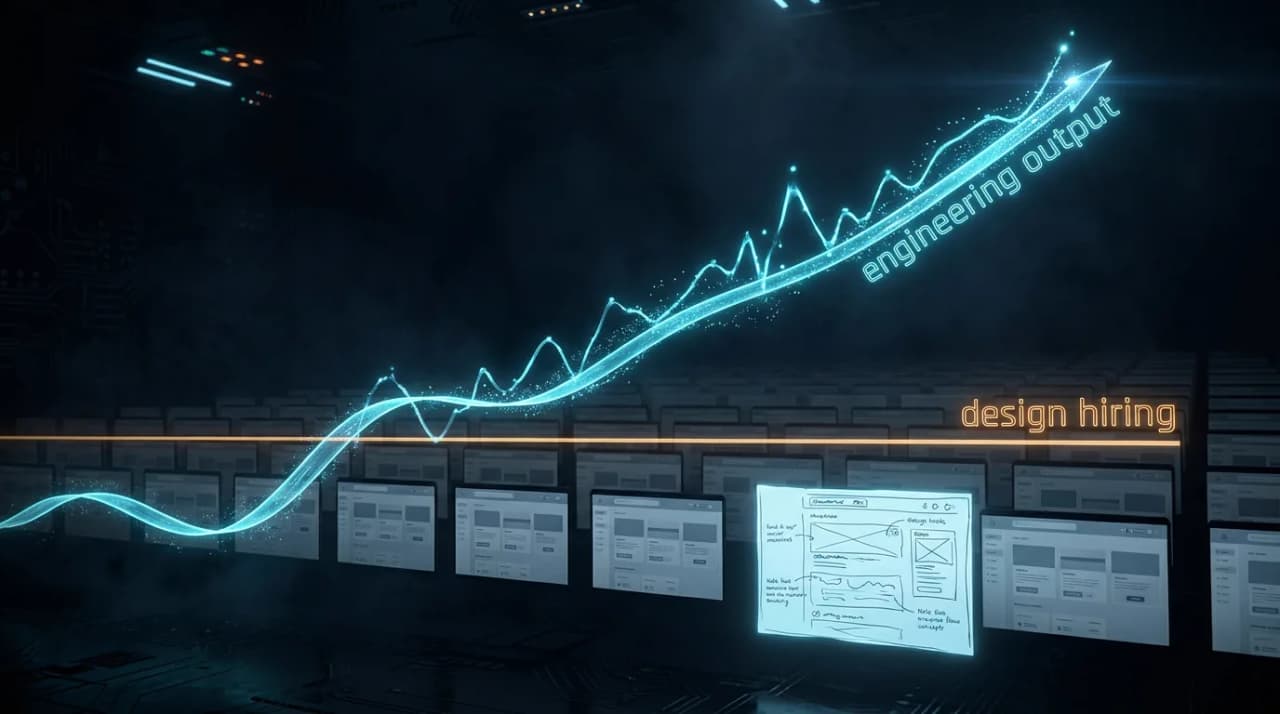
- Engineering output has 2–3x'd across AI-native teams in the last eighteen months. PM headcount stayed roughly flat. Design headcount plateaued hardest of all three.
- The standard explanation (AI is replacing designers) is wrong. Design hiring stalled because most orgs hire for pixel production, which AI commoditises, rather than taste-making, which it does not.
- The design functions that will outperform in 2026 aren't bigger. They're composed differently: fewer production designers, more senior design judgment, a design systems practice that feeds both humans and agents.
Walk into most product orgs in 2026 and the same pattern is visible. Engineering is shipping at a pace that would have been unrecognisable two years ago. Product managers are drowning in decisions. Design is delivering the same number of reviews, the same number of screens, with roughly the same number of people, and is falling further behind each sprint.
The natural inference, the one I hear most often, is that AI has replaced designers. Generative UI tools produce decent interfaces. Copilot-flavoured design assistants scaffold flows. If AI can produce an acceptable screen in thirty seconds, why would you hire more designers?
That inference is wrong, and the numbers are already showing it. Teams that under-hired design on that theory are producing the kind of output they deserve: more of it, noticeably worse, and increasingly hard to tell apart from their competitors'. The design function didn't become less important. It's the part of design being hired for that became commoditised, and most orgs haven't separated the two.
Why the plateau is real
Three data points, triangulated:
AI-native company hiring pipelines. In early-stage and growth-stage AI companies I've reviewed in 2025 and 2026, engineering hiring grew 2–4x from pre-AI baseline, PM hiring grew 1.2–1.5x, and design hiring grew 0.9–1.2x. Several companies actively reduced design headcount while engineering and PM grew. No hiring manager explicitly said "we have fewer design problems now." They said "we have more urgent engineering problems."
The senior-designer pullback. The design market for senior ICs and design leaders softened meaningfully through 2025. Compensation plateaued; open roles contracted. This is not the market you'd expect if taste and judgment were being properly valued. It's the market you'd expect if hiring processes were screening for production capacity and the production capacity was being displaced.
The ship-quality erosion. Talk to anyone who has used ten new AI-native products in the last six months. Ask them to describe the interface of any specific one. Most can't. The products all look similar: the same grey-on-white, the same sidebar, the same chat patterns, the same generated iconography. This is not a failure of talent. It's the predictable output of orgs that bought design capacity as a commodity and got commodity design.
None of these data points, individually, proves the plateau is a mistake. Taken together, they describe a market that has mispriced design by mistaking the wrong input for the thing that produces the output.
What AI actually does to design
The honest accounting on this is more precise than either the "design is dead" or "design is more important than ever" camps usually offer.
AI has commoditised, at production-grade quality, a specific set of design activities:
- Translating a wireframe into a high-fidelity screen
- Generating component variations (button states, list treatments, empty states)
- Producing passable iconography, illustrations, and marketing imagery
- Writing competent microcopy for tooltips, error messages, and confirmations
- Scaffolding flows between screens when the flow pattern is conventional
These are real skills. Good designers spent years getting fast at them. They also aren't the skills that explain why the best design functions produce work the rest of the market can't match.
AI has not commoditised, and does not look close to commoditising:
- Deciding what to build in the first place
- Shaping a problem precisely enough that the solution space collapses to a manageable set
- Building and maintaining a design system that expresses a specific point of view
- Judging which of ten AI-generated variations is the one worth shipping
- Feeling, in under five seconds, when a flow is going to frustrate users in a way the analytics won't surface for three months
- Holding a product vision that makes each screen feel like part of the same thing
If you look at that second list, it describes what senior designers, design directors, and design leaders actually do. If you look at the first list, it describes what a lot of mid-level design hiring screens actually test for. The mismatch is the plateau.
How I'd rebuild the design function
At Cotality, I built the UX capability from zero to six designers over several years. The hiring I did then was calibrated for an operating model where production throughput mattered alongside systems thinking. If I were doing that build today, the composition would be materially different, not smaller.
A modern 5–6 designer function, rebuilt for 2026, would sit roughly like this:
- 1 design director. Owns the system, the vision, and the judgment bar. Spends less time reviewing screens than they used to; spends more time maintaining the system and the decision patterns that let everyone else move faster.
- 2 senior product designers. Deep taste, strong systems thinking, fluent with AI design tools (not as producers but as evaluators and composers). Each owns a complex problem area end-to-end.
- 1–2 design systems engineers. A hybrid role that used to barely exist. Half designer, half front-end engineer, fluent with the design system and with the code that implements it. They are the interface between human design judgment and agent-produced output. This role is scarce and absurdly high-leverage.
- 0 dedicated production designers. The role that used to absorb 30–40% of a design team's headcount is mostly gone. The work is either automated, handled inline by engineers using the design system, or split across the senior designers who own their problem areas.
The total headcount is similar. The skill mix is dramatically different. The hiring criteria are different. And the output is different: less commodity screen production, more design decisions that accumulate into a point of view.
Most orgs haven't made this composition shift because their hiring processes are still calibrated for the old mix. They interview for portfolio depth in screens-shipped terms. They screen for proficiency in the tools that are being commoditised. They ask about process in ways that reward the designer who ran four rounds of reviews, not the one who shipped fewer, more opinionated artefacts. The hiring process is selecting for the displaceable work.
The taste problem in hiring
The core hiring issue: taste is hard to evaluate and easy to confuse for experience.
A senior designer with ten years at FAANG-tier companies has seen more work, but has not necessarily developed taste. They've often developed process fluency, political fluency, and production speed. Taste is a compound skill built through shipping, watching how things fail, and iterating. Many excellent production-era designers never had to build taste because their orgs had strong design systems and strong design leadership doing the taste-level work. They were good at their jobs. They might not be good at the jobs now being hired for.
The fix is portfolio-driven and judgment-driven in interview loops:
Pick three pieces of their shipped work. Ask them to show you a piece they're proud of and a piece they'd change. Listen for specific reasons. Generic answers signal generic taste. "I'd have cut half the features from this flow" is taste. "I'd explore a different direction" is not.
Show them something you're working on and ask them to critique it. Watch for specificity, willingness to be direct, and ability to articulate why. A senior designer who can't critique freshly and honestly is not a senior designer regardless of their title history.
Show them three AI-generated variations of a flow and ask them to pick one to ship and explain why. This directly tests the skill the role now requires. Candidates who struggle with this interview question struggle with the daily work too.
Ask who they'd hire onto a five-person design team. The answer reveals how they think about composition. Candidates who want a production-heavy team are hiring for the old model. Candidates who want a systems-engineer hybrid and a strong director are thinking about 2026.
This is not a process change. It's a screening change. Most of the interview loop stays the same. The difference is what you test for, and what signals cause you to pass or reject.
What happens if the plateau isn't broken
The plateau has a predictable downstream effect: products start to look the same. Every AI-native company ends up shipping the same interface patterns because they're sourcing them from the same generative systems and they lack the design leadership to impose a distinct point of view. The result is a market where the UX differentiation that used to separate great products from good ones collapses, and products compete on feature velocity and pricing instead.
This is already happening. Look at the last ten AI products you tried. If you can describe the UX of more than two or three from memory, those two or three are the ones that had design leadership willing to ship an opinionated interface. The rest look like the generative default.
Feature velocity without differentiated design is a race to the bottom. Pricing without differentiated design is even worse. The companies that break the design plateau, even by hiring just one design director with real taste, will produce products that don't look like everyone else's. That is a larger competitive moat than most product leaders realise, because it compounds across every surface the product touches.
The hiring move in 2026
If you're a hiring manager inside a product org, the practical move is not to hire more designers in aggregate. It's to:
- Audit what your current design team actually does in a typical week. If more than 50% is production work (screen delivery, component creation, icon work), your design function is exposed.
- Convert one production-heavy role to a design systems engineer. That single hire usually pays for itself in design-engineering handoff savings within two quarters.
- Elevate a senior designer into a taste-bearing role with explicit authority over the design system and the vision. If nobody has that role today, your function is making decisions by committee and shipping commodity output as a result.
- Stop hiring for generative tool fluency as a primary signal. Everyone will have it within twelve months. What remains scarce is judgment about which generation to ship.
The pattern is not unique to design. Engineers are going through a similar repricing, where production capacity became commodity and architectural judgment became the scarce input. The timeline for design is a few quarters behind, but the end state is the same: fewer people, composed differently, producing better work than the bloated teams of the previous era.
The orgs that figure this out first will quietly have better-designed products than their competitors. Not because they hired more designers. Because they hired for the part of design that the rest of the market is still overlooking.
Frequently Asked Questions
Is the design plateau evidence that design is becoming less important?
No. It's evidence that the specific skills most hiring processes screen for have been commoditised, while the skills that actually differentiate good design from generic design have not been. Orgs that treat the plateau as "design matters less" are making the mistake the market is about to punish. Orgs that treat it as a signal to re-calibrate what they hire for will come out the other side with better design than they had before.
What's a design systems engineer exactly?
A hybrid role, maybe 60% designer and 40% front-end engineer, who owns the design system as living code. They maintain component libraries, enforce design tokens, write the scaffolding that makes AI-generated output conform to the system, and sit between the design director's decisions and the engineering team's implementation. The role has existed in fragments for years; it's becoming the load-bearing role of the modern design function because it is where human design judgment becomes executable infrastructure.
Should we fire our production designers?
Almost never. Good production designers usually have latent taste that their previous role didn't exercise. The move is to re-scope their work toward problem ownership or design systems contribution, with training time to develop the muscles that weren't being used. The ones who can make the shift are some of the most valuable designers in the function. The ones who can't are likely leaving the market anyway as production work continues to automate.
Does this apply to small teams or only larger orgs?
More pointed at smaller teams, actually. A five-person product team that over-invests in production design is losing more proportionally than a fifty-person team making the same mistake. In smaller teams, one strong design director with taste and a good design system can carry a team that ships better-designed work than a ten-designer org without that leadership.
Related: AI Multiplied Your Engineers. Your PMs Are Drowning. and Taste Is the Last Skill AI Can't Commoditise
Logan Lincoln
Head of Product based in Currumbin Waters, Australia. Led a $70M regulated B2B SaaS portfolio at Cotality, then founded OpenChair and took its product strategy from market entry into paid production use.