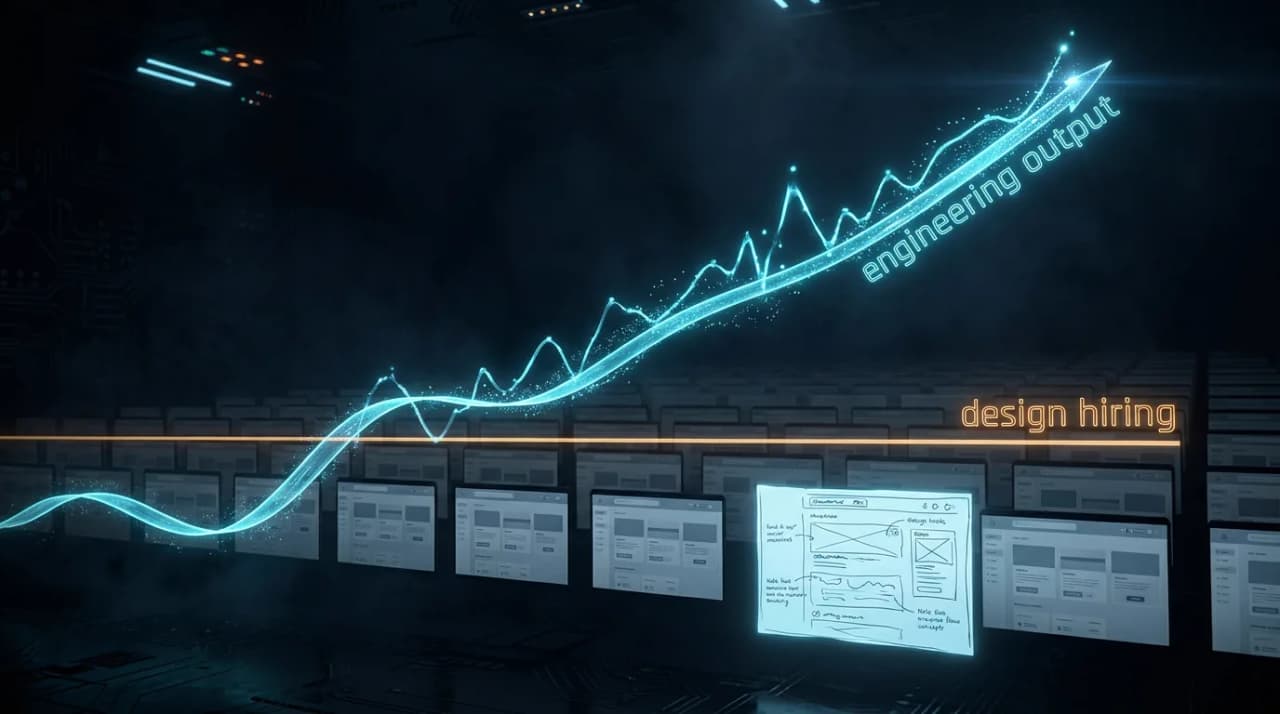
The Skills That Got You Promoted Are the Ones Making You Obsolete

TL;DR
- The operating skills that defined senior product leadership from 2010–2022 (roadmap theatre, stakeholder alignment, spec writing, consensus-building) are becoming liabilities, not assets.
- Weak performers have no sunk cost and reinvent easily. Strong performers have an identity built on skills the market no longer rewards, and they reinvent last.
- The fix is not retraining. It's recognising that your shadow superpower is draining the time you'd otherwise spend acquiring the new one.
Ten years into a product leadership career, you tend to have one skill you're quietly famous for. Running the quarterly review where three VPs disagree and leaving with a roadmap they all signed. Translating a half-formed exec whim into a crisp engineering brief. Unblocking a stalled initiative by walking the hallway and collecting nods before the next meeting. The specific skill varies. The pattern doesn't.
I've watched senior operators build careers on these skills for fifteen years. They're real. They were also the scaffolding of a particular operating model: big orgs, slow cycles, layered approvals, information bottlenecks that required human relays to clear. That operating model is being actively dismantled by AI tools that move information instantly and collapse the translation layer entirely.
The skills that made you senior are now the skills making you slow.
Why success is harder to reinvent from than failure
The counter-intuitive part of this is that the people with the most to lose are the ones least positioned to pivot. Every career coach has the inverse intuition: senior people have resources, networks, time to learn. They should reinvent faster, not slower.
The observable pattern is the opposite. Senior operators I've worked with for a decade are the ones I now watch freeze. Mid-career PMs who were never extraordinary at the old game are picking up AI tools faster than the people who once outranked them. The junior cohort is ahead of everyone.
Three forces explain this inversion.
Identity lock. When your professional reputation is built on a specific skill, letting go of that skill feels like letting go of yourself. The senior PM who built a career on stakeholder alignment doesn't just need to learn new tools. They need to accept that the thing they were best at no longer produces outsized outcomes. That's an identity reframe, not a skill gap.
Time allocation inertia. The activities that earned your seniority still fill your calendar: the reviews, the one-on-ones, the briefing decks, the escalations. Acquiring new skills requires time that's already committed to outputs the organisation still rewards. Nobody frees up two hours a day by cancelling the status review that their VP still expects. So the new skill never compounds because it never gets the reps.
Validation drift. Your peer group, your manager, your board reward the old behaviours. Nobody is going to thank a VP for spending three hours prototyping instead of three hours aligning. The validation signals lag the operating model by about eighteen months. By the time the board starts asking about eval coverage, the senior leader who ignored prototyping for those eighteen months is already behind the person who didn't.
Weaker performers escape all three. No identity to defend. No senior calendar stuffed with reviews. No prestigious validation loop to disrupt. They just pick up the tool and ship. Which is why the reinvention is happening from the bottom and middle of the org, not the top.
What the shadow superpower looks like in product leadership
The specific form varies by speciality. Five versions I've watched up close:
-
Roadmap theatre. The skill of producing a beautifully-staged roadmap artefact for a quarterly review. The underlying work (actually deciding what to build) took a fraction of the time. The artefact is the deliverable the system rewards. Agents now generate better artefacts in minutes. The person who spent a decade mastering this now looks like they're performing busywork, because they are.
-
Hallway alignment. The skill of getting three sceptics to nod before the committee meeting. Requires calendar access, political capital, and time. Obsolete when decision-makers can pull the ground-truth data, run their own scenarios, and form a view before the meeting even gets scheduled.
-
Spec-to-team translation. The skill of converting fuzzy exec intent into engineering-ready specs. This used to be the load-bearing work of mid-to-senior PMs. Agents that can read a Slack thread, a Loom recording, and a customer ticket in sequence and generate a draft spec have eaten this skill almost completely.
-
Org-wide coordination. The skill of running a multi-team launch across product, design, legal, sales, and support. The scaffolding is meeting rhythms, status trackers, escalation paths. All of those are being absorbed into agentic product operations. The coordinator who spent a decade being indispensable now finds their coordination artefacts generated automatically.
-
The seasoned intuition call. The skill of arriving at a product judgment faster than the data arrives, based on pattern recognition from years in the space. This one survives, but only if the senior operator is willing to expose the intuition to new evidence. The ones who treat the intuition as the output instead of the input are the ones who get blindsided by AI-native competitors reading the same evidence differently.
None of these skills were fake. They produced real value in the operating model that rewarded them. The issue is that the operating model moved, and the muscle memory didn't.
The Cotality version of this I watched up close
At Cotality, when we transitioned from legacy waterfall squads to outcome-based delivery, the leaders I expected to make the jump easiest were the ones who struggled most. They had decades of production experience. They had the relationships. They had the domain depth. They should have been the first wave of converts.
Several of them instead produced a steady flow of very polished documents explaining why the new model wouldn't work in their part of the business. The documents were persuasive. They were also the output of the old operating model, which rewarded persuasive documents. The leaders producing them didn't see that they were using the shadow superpower to argue against the thing that would make the shadow superpower obsolete.
The leaders who made the jump weren't the ones with the most seniority. They were the ones whose shadow superpower was weakest. They had less to protect. So they showed up to the new ceremonies, did the unfamiliar work, accepted looking clumsy in front of their peers for a quarter, and came out the other side operating natively in the new model.
I took that lesson forward when I built the UX function from zero to six designers. Hiring for the new model mattered less than hiring people willing to be uncomfortable in the old one. Some of my strongest early hires were people who had been middling performers at their previous company. They had no shadow superpower to unlearn.
The honest diagnostic
If you're senior enough that this essay stings, the useful question isn't whether you have a shadow superpower. You do. The question is which one.
Three diagnostics that have worked for the people I've coached through this:
What's the task your calendar defends? Look at the last four weeks. What activity shows up five or more times and is listed by name in the title? That's the task your time is committed to. If an AI tool could produce 80% of the output in 10% of the time, you've identified your shadow superpower. The fact that you're still spending the hours is the tell.
What do you brag about without meaning to? When you describe your work at a dinner, what phrase comes out unbidden? "I'm really good at getting people aligned." "I can pull together a deck at midnight." "I'm the one who makes the numbers make sense for the board." That sentence is the shadow superpower speaking. It's the skill your identity is built on. Now ask: does that skill still sit at the scarce end of the market?
What does the best 25-year-old in your space do that you don't? Not what do they do badly (you can find that easily). What do they do with zero effort that you'd find hard to start? That's the skill your shadow superpower is blocking. If you're honest, the answer is usually some version of shipping an AI-powered prototype in an afternoon, or running evals on their own output, or reading the token economics of a product like you used to read a P&L.
The fix is not more work. It's different work.
The instinct senior operators reach for is to add. Keep the existing responsibilities. Layer on AI skill development. Spend nights and weekends catching up. The research on this is clear and the outcomes I've observed match it: this almost never works. The old responsibilities absorb all the marginal time and the new skill never compounds.
The move that works is to stop. Not permanently. But long enough to break the validation loop.
Drop a responsibility. Stop running the weekly status review. Let the junior PM own the roadmap deck. Decline the cross-functional steering group. Use the recovered hours to ship something, even something small, with AI tools you haven't used before. Make it an output you can point to. Let the discomfort of looking less senior for a quarter be the price of staying employed at your seniority level in two years.
The career coach framing of this is to "reskill." That framing is wrong. You already have the skill; you just haven't used it. What you need to do is stop performing the old one long enough for the new one to develop receipts. You have to be willing to be less good at the thing you used to be great at.
The senior operators I've watched make this transition successfully all have one thing in common: they got comfortable with being the second-worst person in the room at the new skill, in rooms where they used to be the best person at the old one. That is the actual cost of reinvention. Time is abundant. Ego is the scarce resource.
What this implies for org design
If the shadow superpower is real, the implication for how organisations build AI fluency is uncomfortable. The standard approach is to train the senior cohort first on the theory that their influence cascades. That approach will underperform in almost every company that tries it, because the senior cohort has the strongest identity lock on the old skills.
The better sequencing is to train the middle, empower the junior cohort to ship in new ways, and invite the senior cohort in only after there are concrete artefacts to react to. Seniors learn faster from evidence than from frameworks. An IC who shipped a working prototype in a week produces more adoption signal across a leadership team than a year of AI strategy workshops. Hands-on beats theoretical every time; the question is whose hands.
This is also why the hub-and-spoke operating model works better than pure centralisation for AI adoption. The hub sets the guardrails. The spokes do the shipping. The shipping is where the skill compounds. Senior leaders who try to own the AI agenda by centralising it end up protecting their shadow superpower at the expense of the capability build.
The unflattering conclusion
If you got promoted to VP, SVP, or CPO between 2016 and 2022 by being exceptional at the old operating model, the career risk you carry right now is larger than the risk your less-accomplished peers carry. Your market value was priced by a system the market is now replacing.
This isn't fatal. It is a specific kind of work that most coaching, most training programmes, and most internal talent development is not designed to do. The work is unlearning.
The good news: unlearning is fast once you're willing to start. The bad news: almost nobody is willing to start before they've already been passed by someone who had less to unlearn in the first place.
The senior operators who thrive in the next five years will not be the ones who "kept up." They'll be the ones who had the clarity to name their shadow superpower, the honesty to put it down, and the willingness to rebuild as a product builder before the market forces the choice on them.
Frequently Asked Questions
Is the shadow superpower concept just "sunk cost fallacy" dressed up?
Partly, but it's sharper than that. Sunk cost explains why people hold positions they shouldn't. The shadow superpower explains why they keep producing the specific output they shouldn't, even after they've intellectually accepted the shift. It's an identity and muscle-memory problem, not just an economic one. Sunk cost can be argued with. Muscle memory has to be retrained.
Do all senior operators have a shadow superpower?
Anyone who built a durable career in the 2010–2022 operating model has one. The specific form varies. The underlying pattern (the most valuable skill in the old system becoming the least valuable one in the new system) is nearly universal. The exceptions are operators who never specialised, or whose speciality happened to be something AI-proof like deep taste or customer relationships. Those are rarer than the people who think they qualify.
Isn't some of this just ageism repackaged?
No, although the two can look similar from the outside. Ageism is about discrimination by age independent of capability. The shadow superpower pattern is about capability that the market has repriced. A 50-year-old operator who rebuilt their skill stack will outperform a 28-year-old with the same stack every time, because experience compounds against skill. The filter is specifically about the skill profile, not the person carrying it.
How long does unlearning take?
Faster than learning, in my experience. Most operators I've coached through this hit the inflection point inside six months once they commit to dropping an old-skill responsibility. The commitment is the hard part. Once the calendar opens up and the identity reframe is accepted, the new skill compounds quickly because the underlying judgment is already there. The bottleneck is almost always willingness, not capacity.
Related: I Don't Deal in Hype: Why AI Product Builders Must Ship and Stop Reading About AI. Start Shipping With It.
Logan Lincoln
Head of Product based in Currumbin Waters, Australia. Led a $70M regulated B2B SaaS portfolio at Cotality, then founded OpenChair and took its product strategy from market entry into paid production use.