Your Job Isn't Going Anywhere. Your Tasks Are.
TL;DR
- Jobs are bundles of tasks, and AI replaces tasks long before it replaces jobs
- The organisations that understand this restructure around task reallocation, not headcount reduction
- I watched this play out across a portfolio of eight products, two acquisitions, and sixty people over nine years
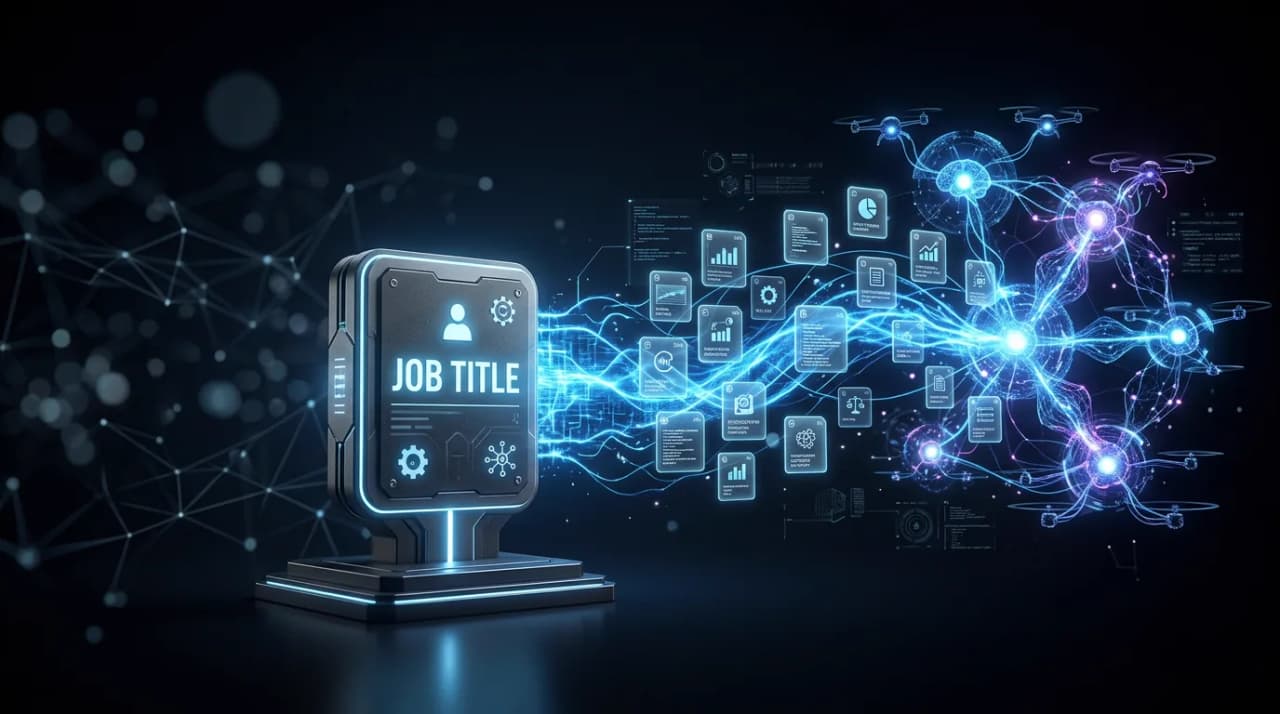
Economists have a useful framework that almost nobody in product or engineering uses: a job is a bundle of tasks.
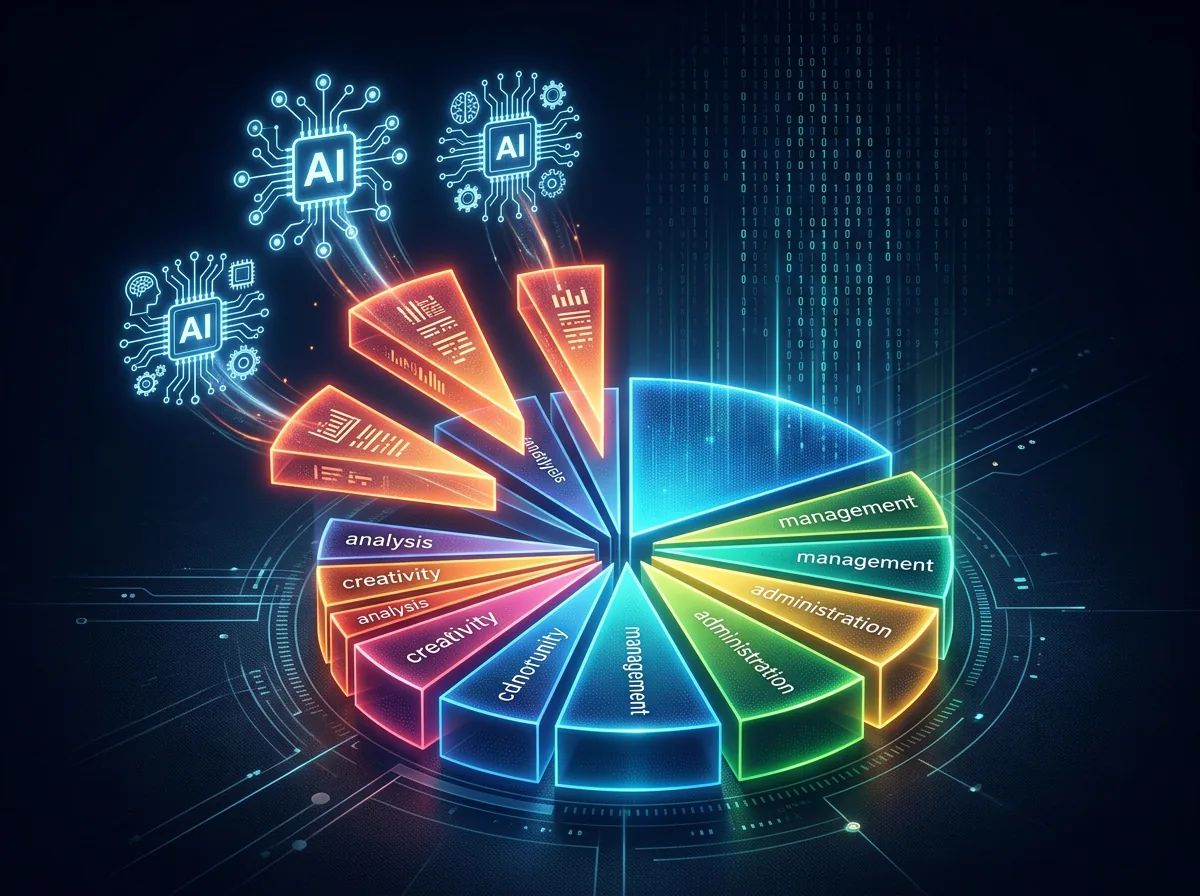
Not a title. Not a salary band. A bundle of discrete tasks that someone performs, packaged together for organisational convenience. When people talk about "AI replacing jobs," they're using the wrong unit of analysis. AI replaces tasks. The job persists longer than any individual task inside it, because the bundle gets recomposed.
This isn't theory. I watched it happen in real time.
How does AI change the task bundle inside a job?
Between 2016 and 2024, I ran a product portfolio at Cotality (formerly CoreLogic Australia) that grew from three products to eight. Across that period, the tasks inside every role on my team changed dramatically. The job titles barely moved.
Take product managers. In 2018, a PM on my team spent roughly 40% of their week on what I'd call "translation work": writing specs that restated business requirements in language engineers could act on, attending standups to relay status, maintaining Jira backlogs, formatting stakeholder updates. By 2023, that number was closer to 15%, not because I cut it, but because tools compressed it. Better async communication. Better documentation systems. More direct engineer-to-stakeholder contact.
The PM job didn't disappear. The tasks reshuffled. That freed 25% of the week for higher-value work: running customer interviews, shaping pricing experiments, analysing competitive positioning. The PMs who adapted thrived. The ones who clung to the translation tasks as their identity struggled, because the tasks that defined their self-worth were the exact tasks being compressed.
AI accelerates this pattern by an order of magnitude.
What task replacement actually looks like
When I integrated two acquisitions (Rita in 2021, Plezzel in 2023), I had to rebuild teams around fundamentally different task bundles. The Rita team had been a founder-led startup where one person did product, sales, and support. The Plezzel team had siloed roles with rigid handoffs. Neither structure survived contact with the broader portfolio.
What we built instead was organised around outcomes, not tasks. The tasks themselves became fluid. A person who spent last quarter building sales collateral might spend this quarter configuring SMS automation workflows. The job was "grow this product." The tasks changed quarterly.
AI pushes this further. Consider what's already happening:
Tasks being absorbed right now:
- First-draft content creation (marketing copy, support responses, release notes)
- Data wrangling and exploratory analysis
- Boilerplate code generation
- Manual QA on predictable paths
- Meeting summarisation and action-item extraction
Tasks expanding to fill the gap:
- Evaluating AI-generated output for quality and brand fit
- Designing workflows that combine human judgment with AI execution
- Setting governance boundaries for automated decisions
- Interpreting ambiguous signals that AI surfaces but can't contextualise
- Building the eval frameworks that determine whether AI output ships or gets binned
The people doing the absorbed tasks don't lose their jobs. They lose those tasks. If they can pick up the expanding tasks, they become more valuable than before, because they bring domain context that a new hire wouldn't have.
If they can't, that's a different problem. And it's a leadership problem, not a technology problem.
The secretary didn't disappear. The memo did.
There's a historical parallel that clarifies this. In 1975, if you were a vice president at a large company, you didn't type your own memos. You dictated them to a secretary. The secretary typed them, printed them, sent them through interoffice mail. When email arrived, the secretary's task bundle changed. First, they were printing out emails for the VP to read. Then the VP started reading email directly. Then the VP started writing their own replies.
The secretary job didn't vanish. The tasks reshuffled. Travel coordination, event planning, calendar management, vendor relationships: the bundle recomposed around tasks that required judgment and relationships rather than transcription. Today, executive assistants at major companies are strategic operators. Their title barely changed. Their task bundle is unrecognisable from 1975.
AI is doing the same thing to knowledge work, faster, across more roles, simultaneously.
Why "how many jobs will AI replace?" is the wrong question
The job-replacement framing leads organisations to two equally bad outcomes.
Bad outcome one: defensive paralysis. Leadership decides AI is a threat to their workforce, slows adoption to avoid disruption, and watches competitors pull ahead. I saw this in financial services, where compliance concerns became a convenient shield for institutional inertia. The banks that moved fastest on AI-assisted property valuations gained market share. The ones that waited didn't protect their employees. They just made the eventual transition more abrupt.
Bad outcome two: blunt-force reduction. Leadership decides AI means fewer people, cuts headcount by 30%, and discovers six months later that the remaining team can't absorb the judgment-heavy tasks that the AI can't do. Institutional knowledge walks out the door. Customer relationships fracture. The AI generates output at scale, but nobody is left who knows whether the output is correct.
The right question is: which tasks inside each role are being compressed, and what higher-value tasks should replace them?
This is a design problem, not a headcount problem. It requires leaders who understand both the AI capabilities and the actual work their teams do at the task level.
How do you audit which of your tasks AI will replace?
If you're an individual contributor wondering where you stand, try this exercise. List every task you performed last week. Be specific: not "product management" but "wrote three Jira tickets," "attended two standups," "prepared a stakeholder deck," "ran a customer interview."
Now sort them into three buckets:
-
AI does this better today. First-draft writing, data formatting, meeting notes, boilerplate code, routine analysis. If AI can do the task at 80% of your quality in 5% of the time, it belongs here.
-
AI assists but can't own this. Complex analysis with ambiguous inputs, customer conversations that require empathy and context, architectural decisions with long-term consequences, negotiations. The human brings judgment. The AI brings speed.
-
AI can't touch this. Relationship building, organisational navigation, ethical judgment calls, taste-driven decisions about what to build and what to kill, mentoring. These are irreducibly human.
If bucket one dominates your week, you need to actively migrate toward bucket two and three work. Not because you're about to be fired, but because the task bundle is going to shift whether you're ready or not. The people who shift proactively get to choose their new tasks. The people who wait get assigned whatever's left.
The org chart implication
For leaders, the task-bundle framework changes how you think about restructuring. Instead of asking "how many people do we need?", ask "what tasks need humans, and how do we bundle those tasks into roles that are coherent and motivating?"
When I consolidated four business units into a unified product function at Cotality, the restructure wasn't about reducing headcount. It was about rebundling tasks. Product managers who'd been doing 60% coordination work in siloed BUs got rebundled into roles that were 60% customer-facing. Designers who'd been doing 70% production work got rebundled into roles that were 70% strategic. The org shrank slightly, but the per-person impact grew dramatically.
AI makes this rebundling continuous rather than episodic. The task composition of every role is going to shift every six to twelve months for the foreseeable future. Organisations that treat restructuring as a one-time event will always be behind. The ones that build a culture of continuous task recomposition will compound their advantage.
The job isn't going anywhere. But if you're still doing the same tasks you were doing eighteen months ago, the job is going to start feeling like it's going somewhere, because the bundle is shifting under your feet.
Move with it.
Frequently Asked Questions
If AI replaces tasks not jobs, why are companies still doing layoffs?
Some companies use AI as cover for restructuring they'd have done anyway. Others are genuinely rebundling roles and finding that the new bundle requires fewer people with different skills. The task framework doesn't mean zero job losses. It means the losses are driven by task recomposition, not wholesale replacement. The distinction matters for how you prepare.
How do I know which of my tasks are most at risk?
The tasks most at risk share three properties: they have clear inputs, predictable outputs, and can be evaluated objectively. If you can write a rubric for what "good" looks like in under five minutes, AI will likely handle that task soon. Tasks that require ambiguity tolerance, relationship context, or ethical judgment are more durable.
Should leaders tell their teams which tasks AI will absorb?
Yes, and sooner than you think. Transparency about task-level changes builds trust and gives people time to upskill. The worst outcome is when employees discover their tasks have been automated through a reorganisation announcement. The best outcome is when they've already migrated to higher-value work because leadership gave them the signal and the support.
Logan Lincoln
Head of Product based in Currumbin Waters, Australia. Led a $70M regulated B2B SaaS portfolio at Cotality, then founded OpenChair and took its product strategy from market entry into paid production use.