Conversational Search Is a Lazy UX Paradigm for Proptech
TL;DR
- The race is on: Zillow, Redfin, and Homes.com have all recently launched conversational search "modes" to replace dropdown filters with natural language.
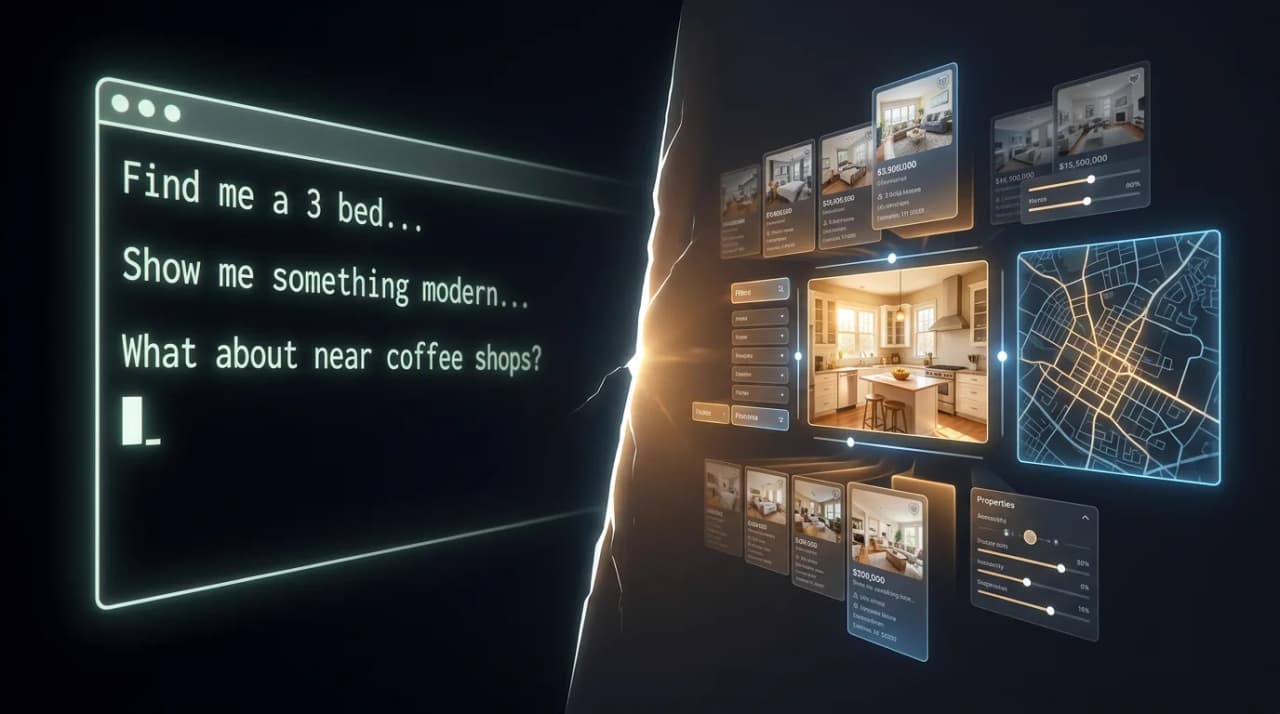
- Chat is the command-line interface of the AI era: it shifts the cognitive burden of "prompting" onto the user. Browsing for property is spatial and comparative, not linear.
- The future of property discovery isn't chatting with a search box; it's generative UI that dynamically molds to implicit intent without requiring a cumbersome 10-turn dialogue.
Between late 2025 and early 2026, the major real estate portals flipped a coordinated switch.
Zillow launched "AI Mode", powered by frontier reasoning models. Redfin partnered with Sierra AI to make the "conversation the interface." Homes.com released Smart Search, and in Australia, REA Group expanded its realAssist conversational companion.
The pitch is compelling. Instead of clicking checkboxes for "3 beds" and "2 baths," you type: "Find me a quiet home with a large backyard for my dog within 20 minutes of downtown." Don't like the results? Iterate: "Show me something with a more modern kitchen."
The technical leap is real. The UX paradigm underneath it is not.
The Problem with 10-Turn Dialogues
Conversational search forces users to compress multi-dimensional, spatial decision-making into a linear text stream. Chat was the first, most obvious way to expose LLM capabilities. Because the underlying technology is a chatbot, product teams wrongly assume the user interface must also be a chat window.
Hunting for real estate is an inherently spatial, visual, and highly associative process about comparing tradeoffs in real time.
If I ask Zillow's AI Mode to "Show me something with a more modern kitchen," the AI dutifully adjusts the results. But if I then ask, "What about homes near coffee shops?", I am forced to hold the entire context of the previous searches in my working memory. The chat interface creates a 10-turn dialogue where the user has to play the role of a hyper-articulate prompt engineer to get what they want, entirely defeating the goal of removing cognitive load from the buyer.
Chat is the command-line interface of the AI era. It is uniquely powerful, but only if you know exactly what to type.
Multilingual and Commute-Based Wins
Some of what these tools do is genuinely good. Redfin's support for long-tail queries in multiple languages is a real accessibility win. The capacity to calculate commute-based bounds ("within a 30-minute drive during rush hour") or affordability reasoning ("What can I afford in Austin for $4,000 a month?") solves real pain points that static search boxes never could.
But these are data routing achievements, not UX achievements. The fact that the system can calculate rush-hour commute times doesn't mean the best way to expose that feature is forcing the user to type out "during rush hour" in a text box.
The Alternative: Generative UI
The endgame for property discovery isn't asking a chatbot for a house. It is generative UI that molds to the user's implicit intent.
If the backend systems now possess the intelligence to understand affordability, commute times, and visual quality (like the modernity of a kitchen), they shouldn't hide that intelligence behind a chat window. Building a default chat interface over a map often means we are overbuilding the technical implementation rather than solving the user's actual design problem. Instead, they should dynamically generate a discovery dashboard tailored to those axes.
If I connect my financial profile, the portal shouldn't wait for me to ask what I can afford; it should dynamically restructure the map around my true purchasing power. If I linger on photos of high-ceiling lofts, the interface should adapt to prioritise architectural volume, generating new toggle controls on the fly that I didn’t even know I wanted.
Take it further. A genuinely adaptive portal surfaces filters you didn’t know you needed, based on what you engage with. Browse five properties with north-facing gardens and the platform adds a sun orientation control to your map. Save three homes near railway stations and it recalibrates your commute assumptions without you saying a word. The AI observes your implicit preferences, structures them, and feeds them back as UI.
This is closer to how a good buyer’s agent operates than a search engine does. A good agent doesn’t wait for you to articulate what you want. They watch you react to properties and update their model of your preferences in real time.
The conversational portals of 2026 are an important stepping stone. They prove the backend intelligence is finally there. The companies that emerge dominant won't be the ones that built the smartest chatbot. They will be the ones that realise humans don't actually want to text message their search engine.
The Relationship, Not the Session
Today's portals are stateless. Every search session starts from zero. You apply your filters, browse for an hour, close the app. The platform learns nothing.
The AI-native portal of the near future treats property discovery as a continuous relationship. It builds a preference graph: your visual style, your spatial priorities, your commute constraints, your price sensitivity, how you trade off garden size against school zones. Each session enriches the graph. After six weeks, the platform's model of your preferences is more accurate than anything you could construct in a search query.
This creates genuine lock-in. Not the artificial kind from data silos. The natural kind that comes from a tool that gets better the more you use it. Switching to a new portal means starting that preference calibration from zero. That's a real switching cost that no feature comparison table captures.
The portals that understand this aren't building search features. They're building preference engines. The chat interface is just the legacy paradigm they haven't discarded yet.
Logan Lincoln
Head of Product based in Currumbin Waters, Australia. Led a $70M regulated B2B SaaS portfolio at Cotality, then founded OpenChair and took its product strategy from market entry into paid production use.